Monthly Archives: March 2012

Foam Rolling 101

Heyyy people!

I’d like to offer some instructional tips for using something that I believe to be a necessity for runners: the foam roller.

I recently received a request from one of my friends Maddy, who has been amping up her regular running, if I could talk a bit about the techniques of foam rolling. Now, I must disclose that I am not even close to certified in anything related to sports science, or real science for that matter. My advice/knowledge comes from having a father who is, quite literally, a sports scientist and from my own experimentation and research. I do a lot of reading on matters related to running, so I like to think I have the fundamentals down—but please know the advice I provide is almost completely based on my own experiences.

With that said…let’s talk foam rolling.
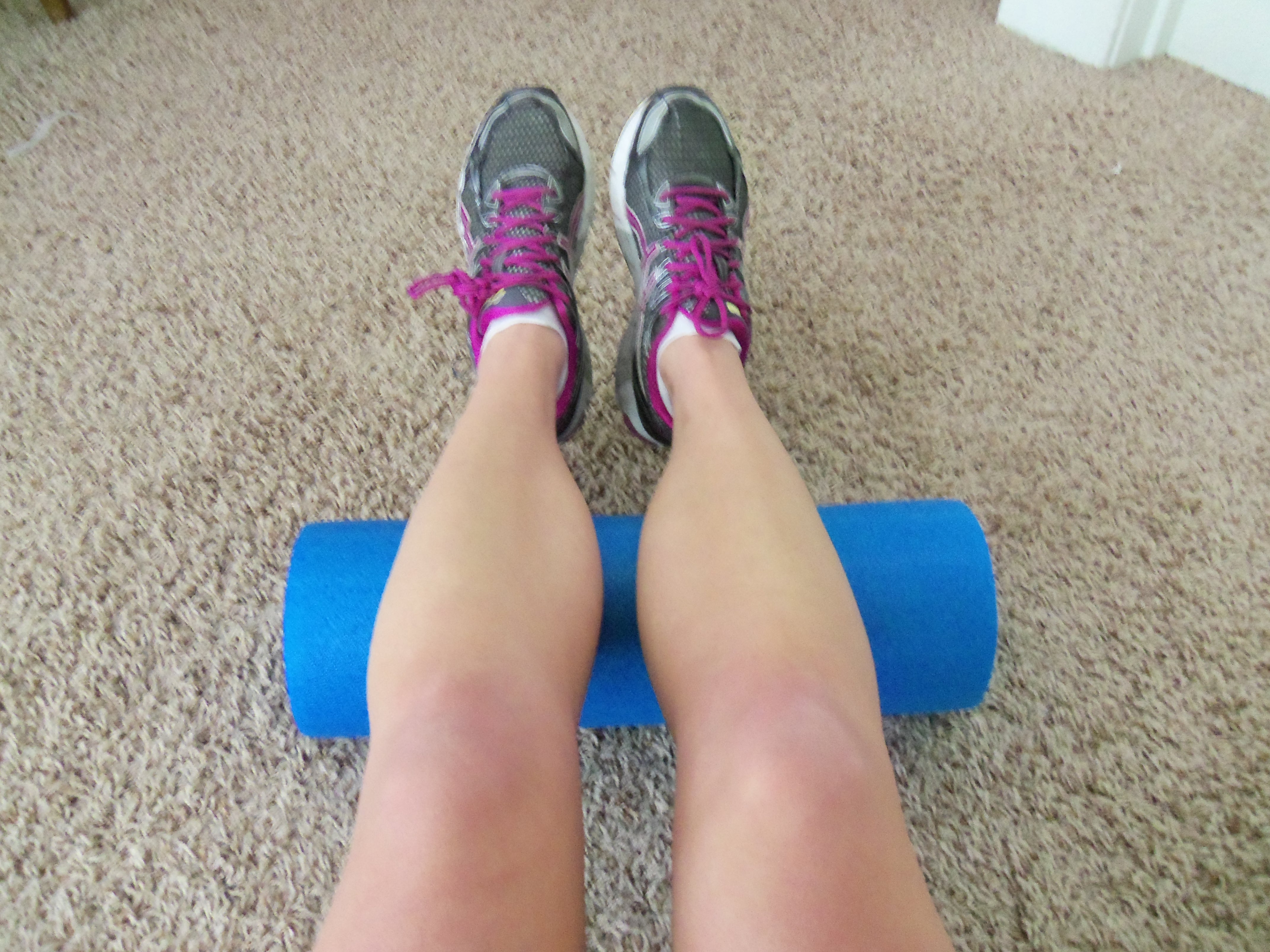


Ah the foam roller. Both the best friend and the worst enemy of nearly everyone who uses it. If you are unfamiliar with what exactly a “foam roller” is, it is very much exactly as it sounds: It’s a log-shaped, rounded tube made of very condensed foam (see above). It is stiff enough to really have an impact, but still has enough give to not make it totally unbearable. You may have seen people at your gym using these contraptions—and chances are they had a very strained/pained look on their face that looked something like this:

This was supposed to be a funny exaggeration, but it's actually fairly accurate.

Frankly, using a foam roller is somewhat excruciating, but once you develop a bit of a tolerance for them, you’ll find yourself very grateful for these massage tools disguised as torture devices.

The most basic use of a foam roller is to relieve your muscles of their tension. By compressing your muscles (especially your big ones like your hamstrings and quads) you allow more blood flow to get to them which releases the lactate that makes you tight and sore. It’s a very self-intuitive device, and you can really contort yourself to “roll” any part of your body you think needs some tough-love.

As a runner, I primarily use the foam roller for my quads, my hips, and most frequently for my IT band. Your IT band is a thickened tissue that extends from the outside of your pelvis, down your hip, all the way to below the knee. This band is known for causing problems in runners, and it’s often the culprit for knee and hip pain.

I’ve included some pictures along with loose instructions for how to go about rolling your primary running muscles. Remember, the foam roller takes some getting used to—and although it might be unbearable at first, if you stick with it you’ll more than likely find it essential for staying injury free. Also, like I said— this device should be used according to what’s comfortable for you, so the techniques I’ll demonstrate aren’t necessarily the only way to use a foam roller. Just suggestions, this is how it works for me. Also, please forgive the awkwardness of my self photo taking…I spent the entire time trying not to laugh.

IT Band

Positioning yourself to roll your IT band is a little awkward at first, but you’ll get used to it. For most people who have never foam-rolled before, you might not even know where your IT band is—I sure didn’t! But, due to the all-mighty/pain inducing powers of the foam roller, it’s not too hard to find. Simply angle your hip/upper thigh above the roller until you feel it land on what feels like a band of tissue. It will probably hurt worse than your surrounding quadriceps, so once you feel a wince of pain—you’ve likely hit the IT band gold. You can stack your non-rolling leg on top of the leg being rolled, or you can use your free leg to stabilize yourself and sort-of push yourself back and forth across the roller. I’ve demonstrated the latter, and it’s definitely my preference.
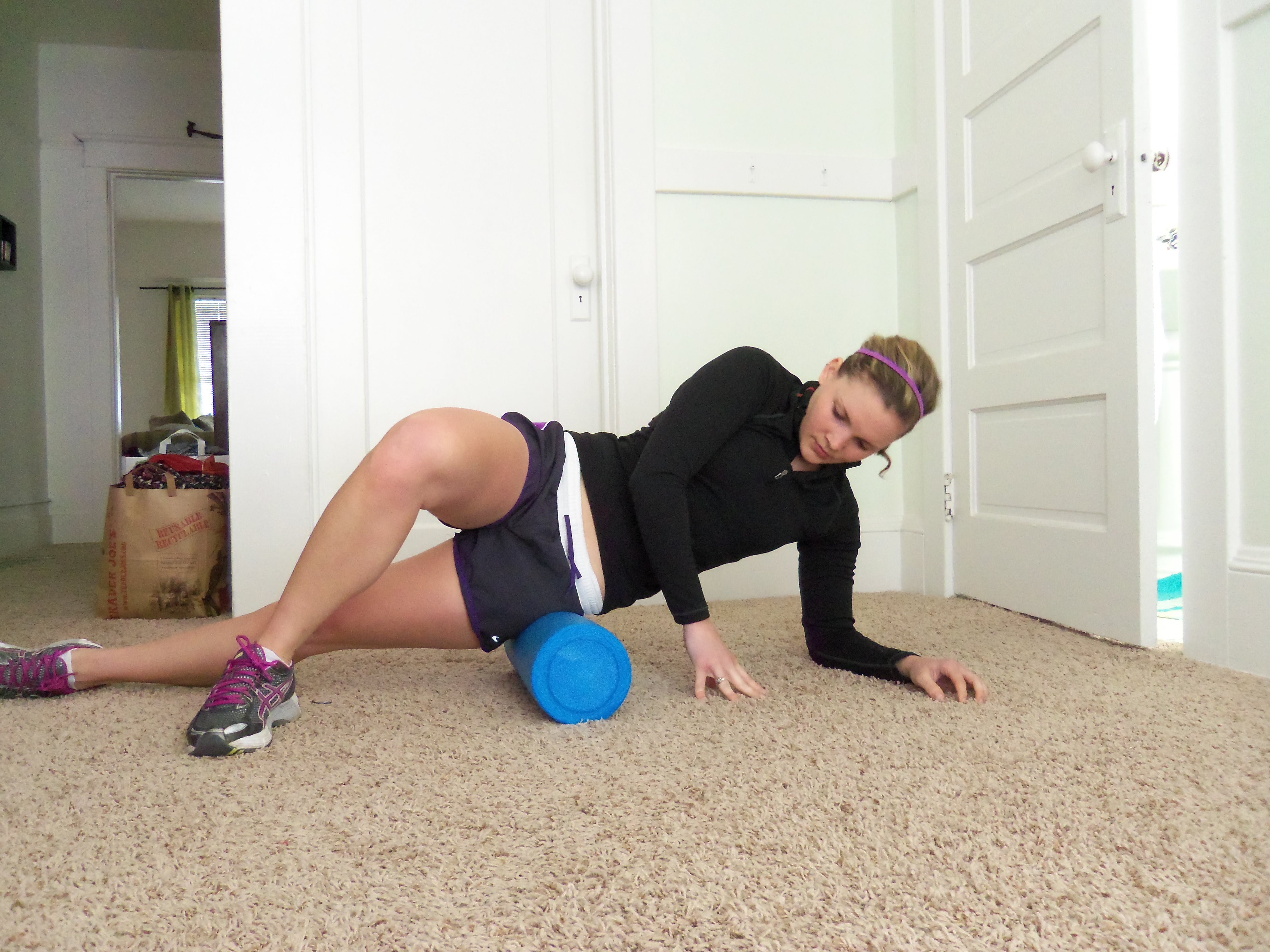
I find that because the IT band covers a large portion of my leg (all of which is used during running), it’s best to roll it out in sections. This way, you can concrete very directly in different areas, giving you a better all-around roll out. The first section I concentrate on starts at the outside of my pelvis, down to just below my hip. I hold a lot of tension here, so I try and work this part really aggressively.

The second section I’ll do is the middle 6 inches or so of my quad. Try and keep the roller primarily on your IT band instead of rolling onto the larger portion of your quad, which can be tempting.

The final section is the area right above my knee. If you are someone who often experiences knee problems with running, rolling this area of your IT band could really help you out. After I finished my first marathon, my left knee hurt so band I could barely bend it—and it was because my IT band had tightened up so much.

I normally try and do about 45 seconds-1 minute per section of the band, or longer if I’m needing extra kneading.

Hamstrings

Lots of runners use the roller to loosen up their hamstrings, and it’s helpful because you can actually do both legs at once. Personally, I find that the simple bend over, touch-your-toes approach to stretching my hammies to be more effective than the roller, but every little bit helps.

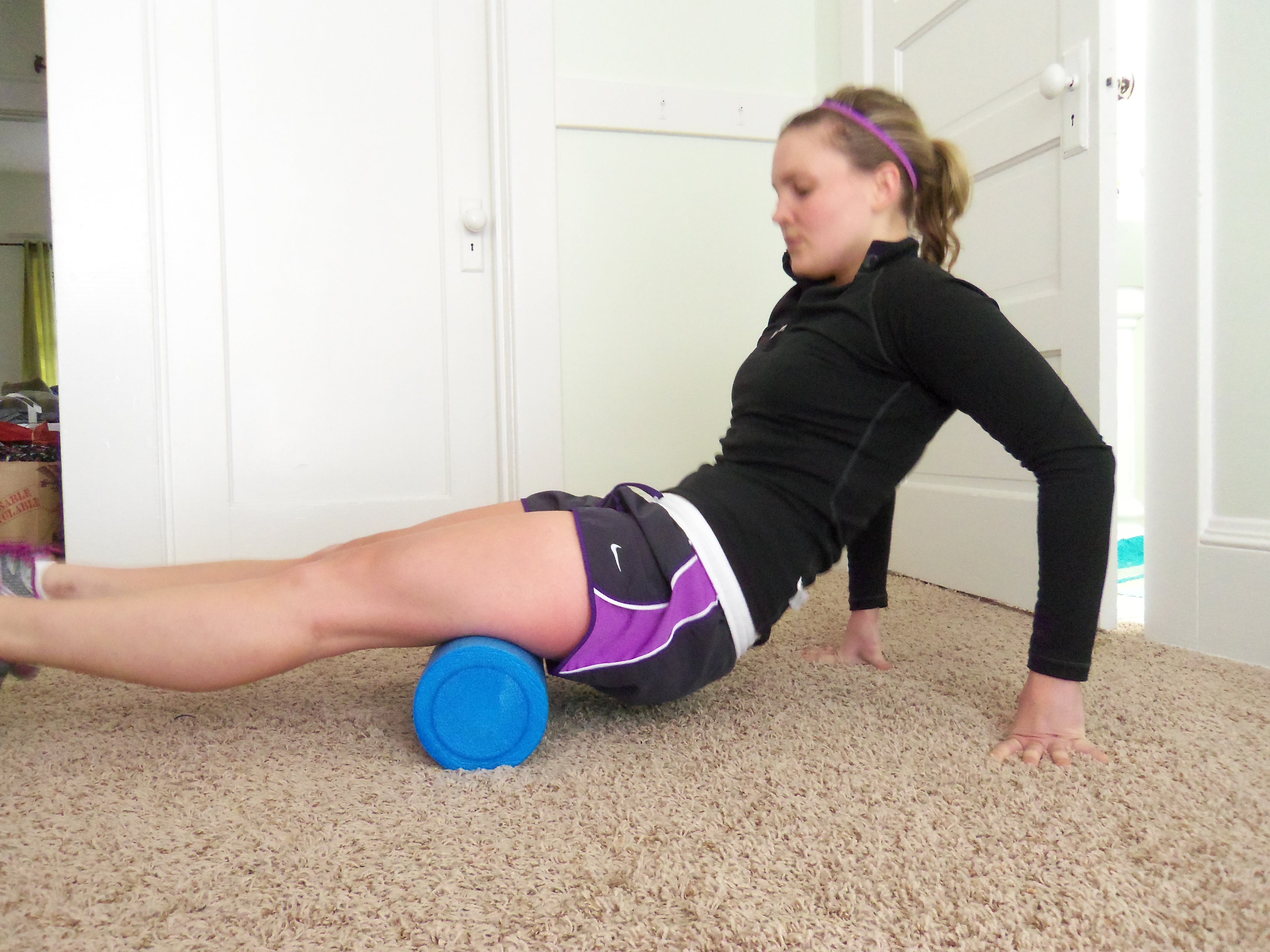
Position the roller underneath your legs, on the area right below your butt. Hold yourself up with your hands about a foot behind you, and you should be able to move your legs back and forth across the roller. You can get experimental with your positioning, increasing and decreasing pressure in different areas.
Quadriceps

Quads and foam rollers have a very love/hate relationship. I’m not going to lie—rolling your quads is intense, and it often takes some conditioning to build up your resilience to it. Nevertheless, it is incredibly beneficial to loosen up such a big muscle, and I personally notice a huge difference in my recovery time between runs when I roll my quads.


The positioning I use for my quads is very similar to rolling the IT band, except I’ll roll a bit more toward my stomach instead of my side. Because the muscle is so big, you’ll probably find yourself rolling side to side in order to cover the whole thing. Again, the device is somewhat self-intuitive and a lot of it just takes some experimentation.

Calves

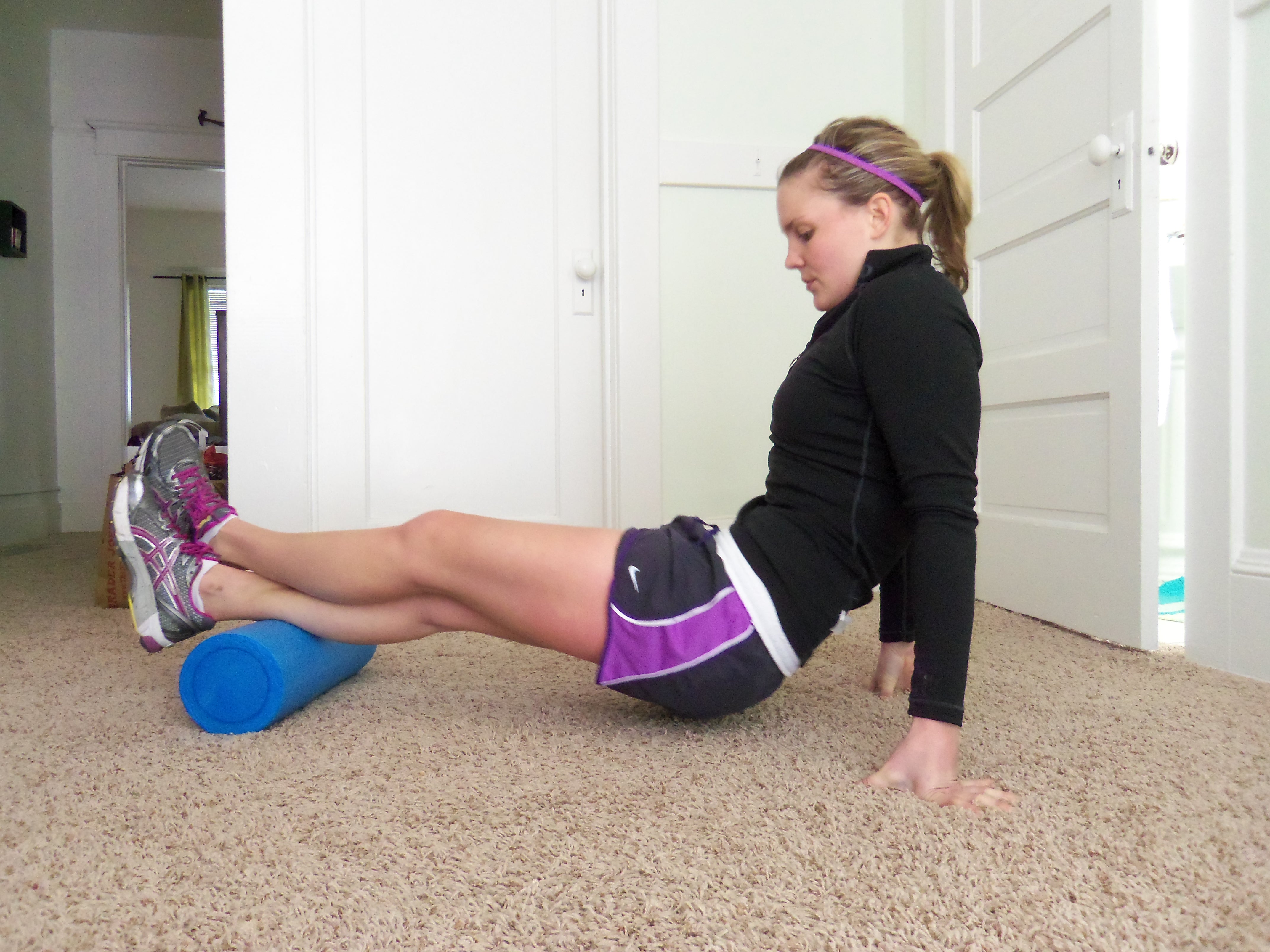
Oh the calves. I know this is where I hold the most tension in my legs, and it’s the area that can always use more stretching and rolling. Typically for working the stiffness out of these muscles, I use The Stick (or, I have someone use The Stick on me), but you can use the foam roller very easily. There are two degrees in which you can roll your calf muscles on the roller, one which is a little less intense, and one that gets a really deep burn.

To roll your calves, position yourself similar to how you would for rolling your hamstrings but with the roller underneath your calves. With your arms bent behind you, hoist yourself up and move your legs back and forth across the roller. This is the first level of calf rolling—it shouldn’t be too uncomfortable, and you can play around with the force by alternating how much weight is in your arms.


If you need a more deep-tissue, intense calf roll, you can place one ankle over another, placing all your weight onto one calf. You’ll definitely notice a difference in how much the distribution change alters the pressure, but just go slow, grit your teeth, and know that your calves are loving it.


Glutes/Piriformis

Yep, running can hurt your bum. Your piriformis muscles, particularly, can get really tight and give a pinched feeling in the middle of your cheeks. Not fun, but foam rolling can definitely help with any pain in your rear—particularly because it’s such a big muscle, and therefore needs some intense massaging to really loosen the tension.

Rolling your piriformis muscle is very similar to the way you situate yourself for your IT band, but instead of positioning the foam roller under your hip, you put it directly on your butt. If your piriformis is tight, you’ll definitely know when you find it, as you’ll feel a bit of a sharp pain when the roller is under it.
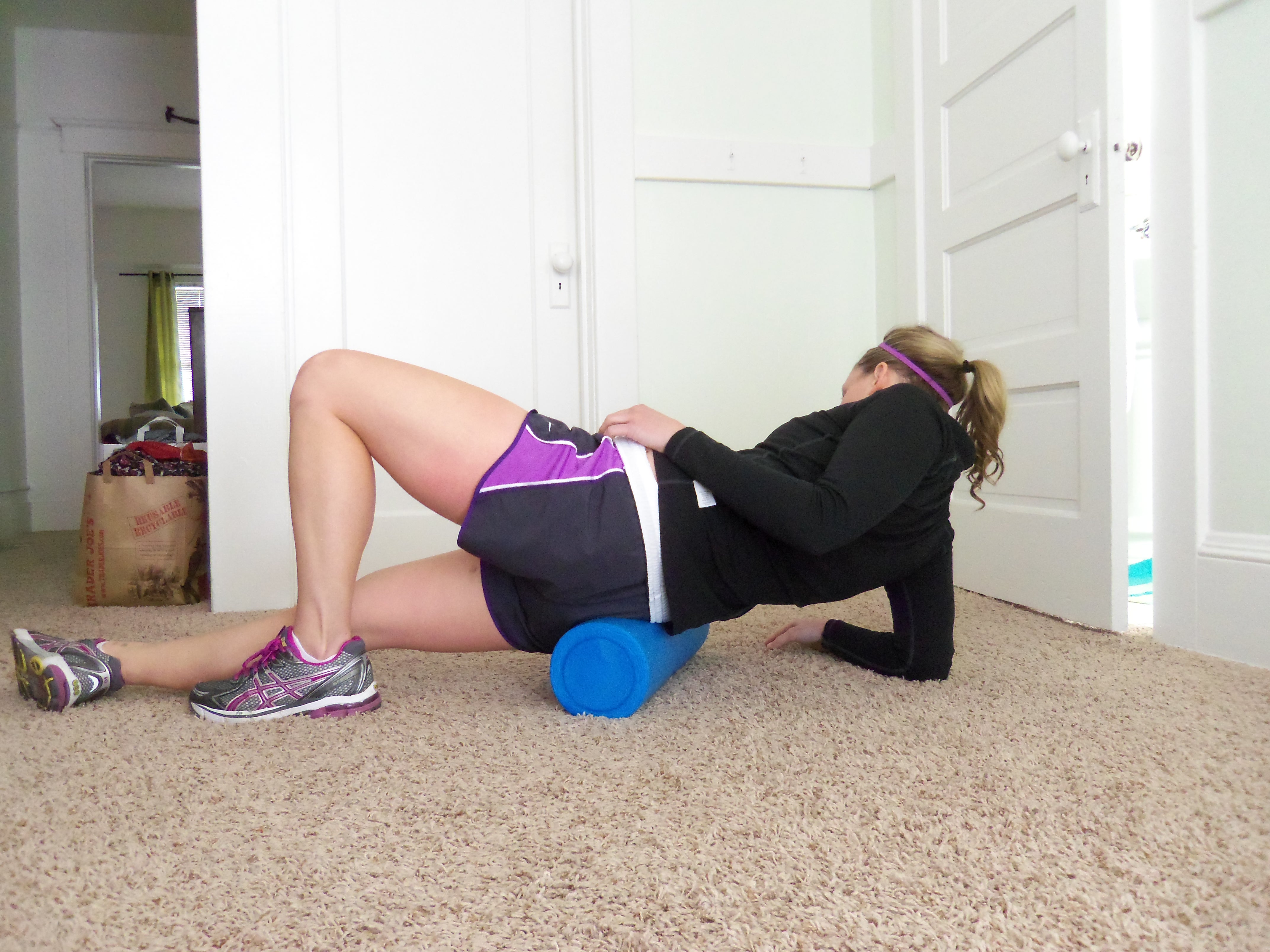


It sounds a little weird, but you should just kind of go to town in terms of rolling out your rear. It’s a tough group of muscles, and so you’ll be able to really roll the heck out of them. And, you’ll be thankful when you don’t feel the pinching feeling of mad piriformis muscles during your runs!


So, there’s a basic overview of foam rolling your primary running muscles. Of course, you can also roll your back and even your arms—but this should suffice as a start to the fundamentals of the roller. So next time you’re at the gym, give one a try. You might feel silly contorting yourself over this strange device, but know that when used appropriately and correctly it is very beneficial to your muscles. There’s a reason why many physical and sports therapists have these buggers in their offices—they are intended to provide a quick, intense, and thorough relief session for your muscles. Once you get more accustomed, the pain of it does start to turn into more of a hurt-so-good massage feel, especially when you know your muscles are in need of the blood flow.

I actually own my own roller, which I bought when I was injured, and although I was a little apprehensive about their pricing, I will say that I think they’re worth it. They are normally around $25-$30, which I know seems expensive for a hunk of foam, but I consider it an investment in injury prevention, which is worth a whole lot!

Let me know if you have any questions! I’ll do my best to answer. Again, I’m no expert, but I’m definitely in a healthy and stable relationship with my roller.

Swimming is Magic

I need to come out and say up front that I know I overreact, and I know my momentary hysterics of thinking I had a stress fracture was probably more exaggerated phantom pain than anything else.

BUT, there was pain there…and that’s part of why I need to offer up credit to the cross training gods and say…

Swimming is magic.

Before I was even hindered with the really bad shin splint on Sunday, I had planned on a long, leisurely swim for Monday. You see, swimming is an old favorite of mine—and the two of us have always gotten along well. Unfortunately, I’ve been neglecting the pool recently in favor of running and spinning, and my only excuse I can claim is laziness. It’s so lame really…but my only hesitation toward a pool workout stems from my aversion to getting in a suit and getting wet. It seems like so much more work than putting on regular workout clothes, and thus my poor goggles, cap, and swimsuit have been left alone in my pool bag from nearly a month.

I was very intentional about swimming on Monday for a few reasons, but mainly because I know how beneficial swimming is to my running, and subsequently my training. I think it was Lance Armstrong who said, “If you want to get stronger cardio-wise, go swim a mile in a pool.”

And you know, Lance is a little more credible than me.

A LITTLE.

It’s very true though. Swimming is positively incredible in terms of what it can do for your fitness. The practice of rhythmic breathing can make a substantial impact on your cardio shape in all other activities, and although swimming laps might seem easier than running—I would beg to differ. If you haven’t swam in a while, I challenge you to go and try swimming a mile; I think you’ll realize it’s a lot better of a workout than it’s given credit for. This is in large part due to the fact that swimming works every muscle in your body. No other activity can accomplish the all-around muscle activity that swimming does, and not only that—it’s all non impact. There’s a reason why people who have been injured in just about every sport are instructed to swim; it’s very easy on your body while still being a very quality workout.

Now, as I’ve said before—there was a time in my life when I had a big huge “running is the only decent workout” stick up my rear. And I admit, today I definitely would prefer running to anything else, however I will also vouch very favorably for cross training, particularly swimming.

Let’s back up to my former running life, when I was reckless and obsessive and demolished my hip.

(I know we’ve talked about this a lot recently, sorry about that.)

Because I decided to quite literally run myself into the ground, I had to accept a fate of cross training or no activity at all. Initially, right after I got hurt, even spinning and the elliptical were a bit too much for my bad hip. Enter, swimming.

I was never “a swimmer,” but I was a lifeguard for many years which means you need to at least be able to bust out a few laps. That said, as soon as I tried swimming with my bum hip, I realized something very quickly; not only could I do it, but it actually made my hip feelbetter.You see, I was so gimpy that I could barely walk—and I began to realize that the days I would swim were much easier to get through (in terms of walking around) than those when I didn’t. Also, when I was swimming it was the only time during the day where I couldn’t feel my injury.

Verdict from this experience?

Swimming=magic

Swimming helped me maintain my cardio shape well enough to jump back into running fairly seamlessly once I was recovered, and I credit swimming for mentally keeping me stable throughout my gimp-hood. There’s a very therapeutic element to swimming laps, and while the monotony can get a bit boring…I’ve found that I can do some of my best thinking while swimming: it’s forced silence that we rarely get to experience.

Oh I frankly can’t say enough, obviously.

I never can though, right?

Anyways, I just want to say that after my lovely 2 mile swim yesterday, I have reconfirmed my belief that swimming has real magical powers.

Remember the post where I decided that in my exercise love life, spinning was my mistress, yoga was the best friend, and running was my one true love? Right, well…if I could fit swimming into the mix, swimming would be the Gandalf. Or the Fairy Godmother, if you will. Yes, Fairy Godmother…I like that. While the other three all argue with each other, my Swimming Fairy Godmother is there to offer relief from the storm and quiet recovery.

And relief she offered.

I definitely was still feeling the shin splint all day yesterday, and even getting into the pool I was a little wary of any aggravation. While breast stroke proved to be a little tricky what with all the foot flexing, I found free style (my go-to stoke) to feel quite good and actually helpful. I ended the swim feeling great, and around 8 pm last night I realized…wait a minute, I can’t even feel the shin splint. Literally the entire day flexing my foot was painful, and just like that, all remnants of pain were zapped out of my leg.

Swimming! Magical Powers! I love my Fairy Godmother!

God I’m such a Disney kid. Sorry.

But for real…the proof gets better. This morning, still pain free, I decided to go along with my Tuesday morning run plan. I figured I would start, and if I felt any aggravations I would turn around and quit. And then all of a sudden…it was the end of my run, and I felt nothing. Nothing! And while it may have just been a seized shin splint that relaxed all at once, I’m giving the credit medal to my beautiful swimming friend.

Oh, and some credit should probably also be given to the fact that yesterday I worked FROM MY BED all day. I was horizontal for the vast majority of my work day (don’t judge…I was freezing and needed to be under my covers), and although I sort of felt like a slug when BF came home and I was literally in the same place he left me…it was worth it.

No more pain! And while I really super hope that this post hasn’t horribly jinxed me and my healthy body, I think it’s safe to end this with a resounding praise for swimming and its magical powers. And lying in bed all day.

Question: What activity do you think has magical powers? Anything goes! Frankly, I think that making chocolate cookies has a fairy-like effect as well.


Injury Psychosis, or “My Irrational 10 PM Panic Attack”

Last night around the time I was supposed to be basking in a post-long-run comatose, I was actually having a panic attack. It wasn’t loud, aggressive, or filled with tears (can you guess how these normally go for me?) but it definitely happened, and it kept my brain a-flutter for far too long.

To summarize, in the space of about 3 iPhone internet searches, I self-diagnosed myself with a stress fracture and resolved myself to a fate of another spring without running and no more Eugene marathon.

Let’s back up a bit though.

Yesterday, I ran 18.5 miles for my long run—a bit longer than I intended on, however I felt great the whole time. Despite a brutal head wind that never seemed to go in the right direction, conditions were ideal for this run, and I was thrilled to be out in short sleeves again. There was really only one thing irking me, and right from the get-go it didn’t really make sense: a shin splint.

I’ve had shin splints before, however that was back when I was running track, and I don’t think I’ve actually had one from running since then. Therefore, I was really confused how after all the mileage I’ve built up and training I’ve done, one persnickety little shin splint would choose to show up out of the blue. It didn’t get worse or anything throughout the run, it just kind of hung out not wanting to go away. After I was done, I noticed that flexing my foot to push the pedals in my car was irritating it—and this put me on edge a bit.

I’m very paranoid about any kind of injury (as most runners are) but I think that I’m particularly wary when it comes to any ache or pain in my body. I go right into prevention/recovery mode whenever I feel something’s off—ice, pain killers, stretching, etc. Last night, the pain still hadn’t subsided, and although I was completely fine in terms of weight-bearing and walking, I still had a pang whenever I would flex my foot.

So, after BF had fallen asleep (yesterday he ran the furthest he’s ever run before—14 miles!), I decided to do what I believe is one of the biggest mistakes runners can do: I went online and tried to figure out what was wrong. Now you see, shin splints and stress fractures are quite interrelated in terms of their similar symptoms, their location, and their frequency in runners. Therefore, when you start Googling anything related to shins and running and pain, you get a very wide range of possibilities for the culprit. This would be the part of the story where I go straight to the worst case scenario, deciding not only that I have a stress fracture but that I can no longer run the Eugene Marathon and must resound myself to swimming and spinning for 6-8 weeks. Not only that, but I actually thought about how sad I would be to read other runner’s blogs and how I would need to try to stay positive in my own blogging. Oh, I also thought, “Maybe I’ll still be able to do the half? But then I’d be so depressed seeing people do the full…and why would my family come if I was only doing the half?”

Okay.

Yes, all those thoughts did go through my head.

No, I don’t have anything near a stress fracture.

Once I woke up this morning and regained a better grip on reality, I realized two things: It’s actually not running or impact that irritates this feeling in my shin (it’s flexing my foot), and I’ve had this pain before—and it definitely wasn’t a stress fracture then either.

After a little more logical and thorough investigation with my sports doctor known as Dr. Google, PhD., I got a little closer to what I think is going on.

Ready for some fancy name-calling? Tibialis Anterior Tendonitis. AKA: Really bad shin splints.

In a nutshell, one of the muscles on the front of my leg has some tendonitis, and it hurts to bend my foot.

So yes, it’s too bad and I’ll be taking all the proper precautions in the mean time, but no…it’s not the completely debilitating injury that my pre-bedtime brain decided it was.

Now, I know many runners are super hyper-aware about getting hurt, and understandably so. However, I do think there was a particular reason I so quickly and dramatically decided that this pain meant the worse case injury. You see, it was almost exactly one year ago to the weekend that I got hurt last year. I actually think it may have been the exact same weekend; I had run my half marathon PR, and like a really super smart person decided to run 9 miles the day after. Thus began the week-long downward spiral of my hip flexor, which ultimately would end up torn and disabling me from being able to walk, let alone run. I couldn’t even run 10 feet for a solid 2 months without my hip seizing in pain, and it would be 3 months before I could run more than a mile.

Those were fun times. No, actually they sucked. However, despite it all I did learn a lot about myself as a runner, and more importantly about my limits.

So, what does all this have to do with my panic attack about a stress fracture?

Well, I can’t be entirely certain, but I do think a part of my brain—that mysterious subconscious part that enjoys playing tricks on you—is in full-force protection mode right now in regards to injuries. Because last year my spring was so wholly down-trodden due to my limping gimp status, I think part of me is really bugged-out scared about the possibility of something like that happening again. And, sure, it’s for good reason—no one wants to get hurt—but for me that period of time is not entirely pleasant to think back to. I have such high hopes for this spring, for this upcoming marathon, and for the plans I have for the summer, and it cripples me to think of them going wrong.

As a runner, I do need to realize that injuries do happen—it’s all in the nature of the sport. I have internalized this, and I feel better prepared for if and when something happens again, but this little bout of panic I had last night made me realize that maybe I’m more afraid of it than I consciously think I am. I know I got through it last time, I know I could get through it again, but I also remember the feeling of disappointment that lasted for months. And that feeling is what I’m most afraid of. Disappointment in myself for not training smarter, disappointment in not being able to cross another marathon finish line, and overall disappointment in missing the glory of a good run.

So I suppose what I’m trying to say is that I’m feeling a bit vulnerable right now, and I know it’s because at this point—I do have a lot to lose.

And in reality, that’s a really good thing.

Sure it’s scary to think that one little slip up could take everything away, but I’m a big believer in the idea that it’s when you’re happiest that you tend to feel the most vulnerable. When you’ve built up a great deal of strength(both literally and figuratively) in your life, you cannot help but feel exposed and be fearful that all your hard work will come crashing down.

It is better to feel like you have something to lose rather than nothing to lose, though. When you have something to lose, in this case—training and mileage build up—it’s because you’ve put dedication into something; you’ve taken time and care into making something happen. The thought of those hours and grueling efforts going to waste is horrifying, but I think we/I should remember that they actually will never go to waste. Sure, if I were to get hurt, there would definitely be a loss in morale and my marathon registration fee, but it wouldn’t take away from the hours I’ve spent on the pavement, loving the feeling of running, and soaking in the greatness that is a runner’s high.

I’m going to try and remember this, as I nurse this pesky shin splint, but also as I think about the future of my running career. This momentary lapse in my better thinking made me realize that part of being a good runner is internalizing the fact that injuries happen, and I need to trust myself a little more. I’ve done everything I can to stay healthy, and if my body doesn’t choose to cooperate—well then, there really isn’t anything I can do about it.

Of course, as with most tough things, this mentality is easier said than done, but I am going to try and focus on the reality of being a runner instead of just the ideals of it.

Obviously running a PR in every race and having a great run every day would be awesome, but it’s not the nature of the beast. Sometimes, we need a little dose of fear to help us realize that running isn’t a submissive mistress. She keeps you on your toes, and you need to listen to her demands in order to maintain a steady relationship.


Icing, ibuprofen-ing, massaging, and resting until this bugger subsides. I’m considering waiting until later in the week to run again, but we’ll see how things go. Thanks for reading my attempts at narrating the complexities of my brain. Sometimes I feel like it’s trying to be an announcer for a 20-person trapeze show…not a cool task.

Questions: Tell me something fun about your weekend! Or, if you’re feeling deep, tell me about your thoughts on the psyche of injuries.


Friday Favorites: Chocolate Eggs and Little Spoons

Not to mimic the probable ranting of everyone you know on Facebook and Twitter, but seriously…

TGI friggin’ F

This week has felt super long, and I haven’t been this ready for the weekend in a long time. Also, while I’m normally all jazz-hands and sunshine on Fridays, today I’m feeling a little blah. Not too great, not too bad…just sort of mediocre.

Which I hate. As someone who gets kicks out of the simplest things in life (free cookie samples! dogs playing fetch! a cute baby sighting!) mediocrity and I do not get along well.

However, it is in fact Friday, which means that some acknowledgment of my Favorite Things is in order.

Fun Fact: I recently discovered that “Friday Favorites” was not in fact the work of my oh-so-inventive imagination, and actually—just about every blogger and their moms do Friday Favorites (Speaking of, mother—what are your favorite things today?). I actually really enjoyed learning about this, because I think these communal favorite-filled posts create a cyber vortex of internet positive energy.

Happiness is infectious people, it’s science.

Anyways, before I get into some Favorite Things, I’ll update you on my Eugene 2012 training, as well as my 2012 miles goal:

Eugene: I don’t really know what “week” I’m in, but this particular week of training is actually a cut-back week in terms of long-run mileage. My run this Sunday will be 16 or so miles, as I get ready to amp up next week for an over 20-miler. I am allowing myself to get passed Sunday before I go into anxiety-mode over that one.

Overall, I’m feeling pretty good. I’m being a little more intentional about my goals for each run in terms of my speed, and although I’m Garmin-less (which would make this endeavor much more legit) I’m finding that my Timex and runningmap.com are working just fine.

2012 Miles: This was originally a “just for fun” goal, but I’m realizing it requires some serious tracking! I normally log my miles in the very official location known as my brain, so I think I’m going to have to start logging somewhere like Daily Mile or even just a planner so I can stop doing long math equations over and over. However, the results are in!

Miles Run in 2012: 373.65

Percentage of Goal: 18.57%

Percentage of Year Over: 16.93%

Hoorah! Still on track. Now, I need to actually get some official recording devices. You people and your fancy things…I don’t know how you do it.

Okay, I’m done with numbers…my right brain has had enough. Time for Friday Favorites! Ready….GO

Trader Joe’s

The sun shines for TJs, even when it's raining throughout the rest of Seattle.

Not to get totally stereotypical young-adult-in-Seattle on you, but I really can’t help myself. I adore Trader Joe’s. Anyone who’s familiar can relate; everything from the free samples every time I go in to the insanely low prices for the unique, natural, and fantastic food selections just drives me wild about this place. I go out of my way to grocery shop here (not every time I shop, of course) and it always feels like an occasion.

GO TJS!


Cadbury Mini Eggs

So, I recently had a bit of a battle royale over Facebook about the debate between Cadbury Mini Eggs and their goo-filled counterparts, Cadbury Creme Eggs. Amusingly, the two people who shunned me the most for choosing the Mini Eggs over the Creme ones were Anna, my best friend, and BF, my…well, you get it.

There may be some domestic disputes erupting shortly, but I’ll hold my ground. These little chocolate eggs are SO much better than the creme eggs. Not that I dislike the creme ones necessarily, but there’s something a little off to me about “creme” that’s been sitting inside something for a likely exceedingly long period of time. Side Note: “Cream” is actually the correct spelling for non-artificial, honest-to-goodness milk cream. I bet you are PSYCHED you know that now.

Also, you can eat more of these little eggs due to their size and packaging, so obviously that makes them better.

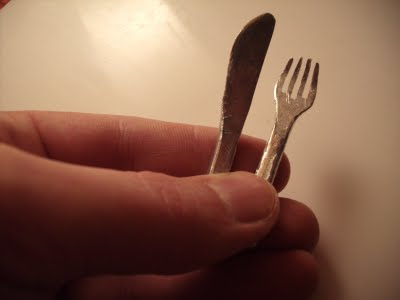
Small Silverware

Please note, this is a dramatization.

I have a confession to several restaurants out there: If you are missing some of your miniature silverware, it’s because it is currently sitting in my utensil drawer.

I am in love with cute little flatware, and I use it as frequently as I can. My “little spoon” (as she is so creatively and affectionately named) gets washed more than anything else I own because of her ample usage. I’m someone who doesn’t understand the meaning of eating slowly or pacing myself on a meal, so another benefit of my little friends is that they sort of force me to at least somewhat control my bite sizes.

And yes, I do use proper pronouns when referring to my possessions.

And before you call the Seattle Police Department, I really have only taken three items from restaurants. Wait, four. But once I have a little knife, I’ll be done with my thievery.

Until then, the hunt is on…

Starbucks Blonde Roast

Now that's a hot blonde.

I have to give accolades to this new brew that you have inevitably heard all the hype about already. While I don’t like super sweet coffee, I do think that when coffee is too strong it tastes like dirt—therefore when my customary drink (a soy cafe au lait) is made with a really bitter roast, I huff and puff a bit about how my coffee is ruined.

The blonde roast, however, guarantees a drinkable cup o’ joe for me, and I’m thankful to have something I can count on.


Glee’s Version of the Kelly Clarkson’s “Stronger”

So, I actually thought I had previously favorited the original version of this song, and apparently that’s not true. Just so K.Clarkson knows, I adore the original version and think it’s insanely empowering—and I love the fact that Glee decided to cover it with an all-female ensemble.

Girl power is a wonderful thing. Go Glee. Go Kelly.

Alright people, what are your favorite things this week? Long run plans for the weekend? Exciting plans for the weekend? Tell me please!!

My Running Report Card

Hello, friends!

Okay, so I might have gotten a little overly critical in yesterday’s post in regards to the commercialization of running. The running industry has contributed so much information and research toward the improvement and accessibility of running, and many of the “rules” they’ve come up with are indeed very credible. My point was simply that you shouldn’t presume every new fact, product, and tip that comes out about running directly applies to you. Running is very individualistic (one of the reasons it’s great) and don’t immediately presume that you’re doing something wrong if “groundbreaking” research tells you so.

With that said, there are particular “running rules” that seem to apply to at least the majority of runners. For example, hydration and carbohydrates are two things that I think all runners can agree are must-haves. I’m constantly kind of laughing at myself and shaming myself for the things I think I do very right and very, very wrong in regards to these running “basics.” Truly, there are some things I don’t do stereotypically “right” that I believe has no impact on my progression as a runner. However, there is definitely room for improvement, which is why I’ve decided to do a little analysis of my good and bad habits, in conjunction with the “rules” of being a good runner. The grades I’ve awarded myself are what I believe the whole of the running industry would give me.


Rule #1 Thou Shalt Hydrate

Grade: B

I always have the best intentions when it comes to hydrating properly. I carry a Camelback water bottle with me constantly, and I awkwardly ask public places to fill it as often as I can. However, I would say I don’t hydrate as often as should given my activity level. I think I’m hydration-proficient when it comes to the Average Person, however given the excess amounts of sweat I create during the day, I should probably be drinking more water—especially later in the day.

However, I really only ever drink water (and one cup of coffee in the morning), so at least my hydration is coming from the purest source.

Changes Necessary? Yes. I firmly believe that runners should pay a lot of attention to how hydrated they are. I know that above all other factors, if I’m dehydrated on a run it makes the most noticeable difference.


Rule #2:Thou Shalt Stretch

Grade: B+

If the “importance of stretching” were limited to pre and post run, I would probably get more of a C in this category. Admittedly, I’m not stellar at stretching immediately after a run, and I hardly ever stretch beforehand. However, I’m a dedicated yogi, and I credit the 2-3 hours I spend a week on my mat toward my stretching grade. This is actually a debatable topic for runners; while many argue for the value of stretching, there are many intense distance runners who claim to never stretch (Dean Karnazes for example…although his “human” credibility is questionable). The science behind the importance of stretching is variable as well, so this is definitely an area where I’d argue to do what works best for you.

Changes Necessary? Not really, BUT that is very dependent on continuing to do things such as yoga and foam rolling. Additionally, BF and I take turns torturing rolling each others’ calves with The Stick (remember that Friday “Favorite”?), which I think helps with our muscle relief. So, I would say my habits are working for me, but the measures I do take to remain stretched and loose must be maintained.


Rule #3 Thou Shalt Cross-Train

Grade: A

I have to say I’m proud of myself for this one. I never, ever used to think that anything other than running was a viable workout. I thought a sweat was wasted if it wasn’t spent on a run, so it definitely took me a while to really learn to appreciate (and love!) a cross-training routine. And truthfully, I was kind of forced to—when I got hurt almost a year ago (due to excessive running) cross training was my only exercise option for a solid three months. And I’m actually grateful for it, because now I not only enjoy other activities other than running, I definitely think they make me a stronger and smarter runner. I 100% believe spinning has helped my speed, swimming has helped my recovery and cardio strength, and yoga has helped quicken my muscle repair.

This is actually another debatable point in terms of “proper” running training. Many people vouch for it, however there is a large number of people who think the only way to be a better runner is to run, and that’s all. I definitely see both sides, and while there are days I’d much rather run than anything else—I know my body really thrives most when there’s variety in my workout routine.

Changes Necessary? Not right now. If there is a time when I’m really looking to amp up my training (either for increased speed or increased race length) then maybe I’ll need to tone down the cross-training, but for now I think that as long as I’m getting my marathon-prep miles in, there’s no reason to cut out the cross training.


Rule #4Thou Shalt Fuel

Grade(s):

Pre-run: B, Mid-run: D, Post-run: A

So, I’ll leave the debate of what to fuel with for another discussion, but in general I would say that the grades above are pretty much how the running industry would rate my fueling abilities. If I have a long run in the morning, I’m better about pre-run fueling for sure, but for just an every-day run I normally only have a handful of cereal and a few sips of water. It could be better for sure, but it does work for me and I have a persnickety digestive system to begin with, so I don’t really care to experiment.

As I mentioned in Monday’s post, I’m really bad at fueling during my runs. Honestly, I’ve tried the whole gummies/gels/etc gunk, and all it does is make my stomach hurt. I wish they worked, and I think I might be able to condition myself to stomach them a bit better, but I really prefer a sports drink instead. That said, I only actually bring fuel on a run if it’s a really long run—another reason for my D grade.

As for post run re-fueling, I think I’m pretty good about the whole “carb-to-protien” ratio or whatever it is we’re supposed to do. I almost always eat within an hour of running, and I make sure that it’s something at least marginally substantial. I can really only credit my voracious appetite to my skills in this category, in that it only takes about 20 minutes after a run to set my appetite a-flame.

Oh, and in terms of calorie replacement after a long run—I have no issues there. See: My addiction to cookies.

Changes Necessary? Some. I would like to be a better mid-run fueler, and I think that as my marathon training increases, I’m not going to have a choice but to get used to the gummy energy thingers—unless I want to feel like total crap by the end. Also, I’ve started to get hungry during my runs more frequently, so I’m thinking I’m going to try adding something a little more substantial beforehand.


Rule #5 Thou Shalt Take Rest Days

Grade: C-

I am really, really trying to get better at this—and I think I am, but as I’ve said it’s not in my nature to intentionally take rest days. I know I justify my lack of rest days with cross-training… as in: well, I’m not running—therefore it’s okay. And actually, there are days where I’ll only do yoga or a light swim, but overall I would say I must be more programmed to completely let my body regroup and relax.

Changes Necessary? Yes, and it’s a work in progress—I promise!


So there you have it. Five very basic rules that I would say the majority of the running world agrees upon. I didn’t even get into shoe replacement, speed work, and proper training plans, because there’s way too much variety and—again—I don’t think there’s one right answer. I actually don’t believe there’s necessarily a “right” answer for the rules I’ve stated.

However, my goal is to show you that sure, there are some guidelines to this whole running thing, and as an active distance runner, I’m both sub par and exceptional for different ones. The point is that while I’ve acknowledged the areas I could improve upon, there are certain nuances that I don’t abide by and it’s no big deal. Not that my running career is scientific proof of anything (English major folks, and a liberal arts school one at that), BUT I hope that I’ve shown the importance of analyzing what works best for you.

So listen to the experts, read the studies, and buy the books, but remember that the most credible source of information is your own body. It knows better than anyone else what does and doesn’t work for you as a runner—and in the end that’s who you should be abiding by.


NOW YOU! What grades would you give yourself for these running “rules”?